Rainy Day Anime Vocabulary Sheet
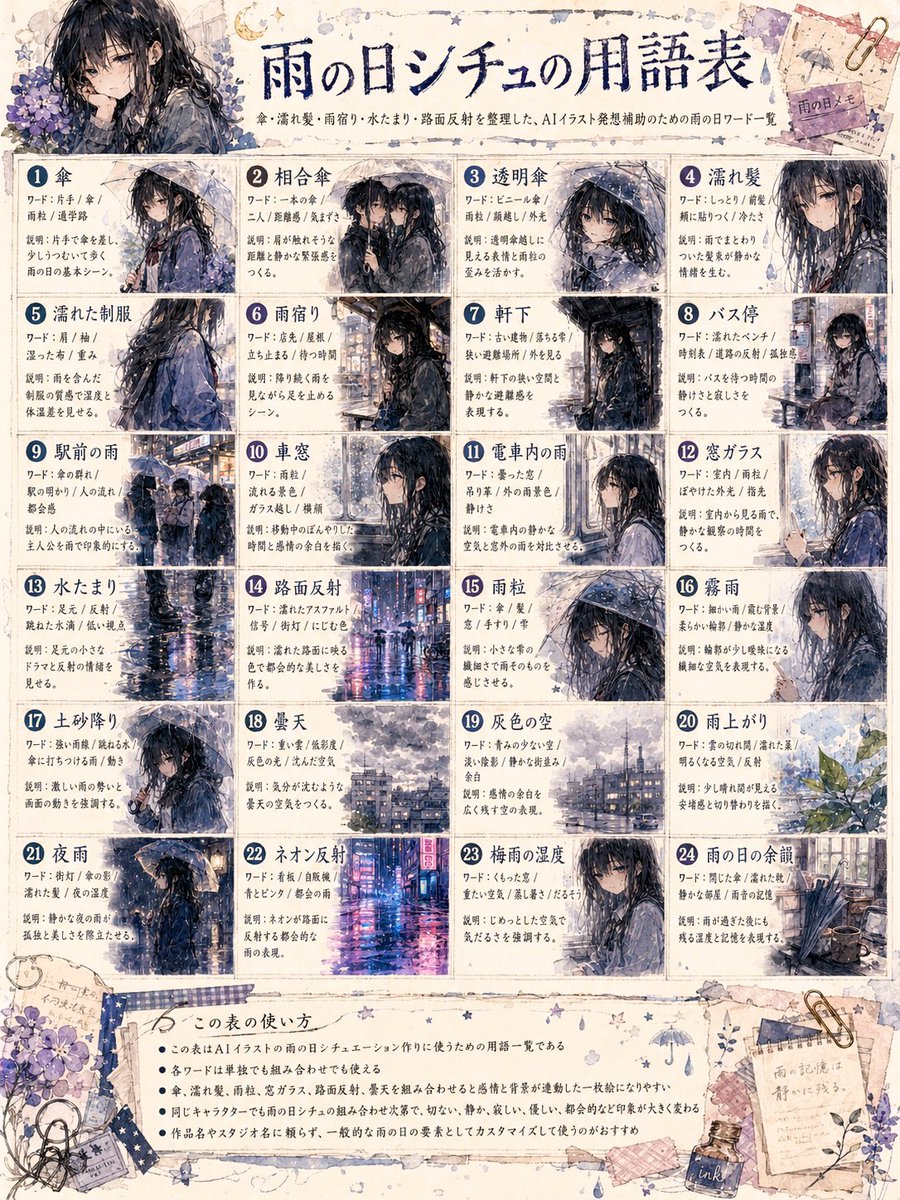
Rainy Day Anime Vocabulary Sheet

Eingabeaufforderung

Goal: Create a detailed Japanese-style illustrated reference sheet infographic titled 雨の日シチュの用語表, explaining useful rainy-day scene vocabulary for AI illustration prompts. Canvas: Portrait 3:4 poster, aged cream watercolor paper with ink stains, tape, paperclips, torn memo scraps, tiny stars, raindrop doodles, umbrella doodles, and purple hydrangea decorations in the corners. Use a handmade scrapbook notebook aesthetic with thin navy divider lines and slightly worn edges. Overall visual style: Soft anime watercolor and ink wash, melancholic rainy atmosphere, muted navy, gray, lavender, and beige palette. The recurring subject is a black-haired anime girl in a dark raincoat, usually wet from rain, carrying or standing under a transparent or black umbrella. Add reflective wet streets, mist, puddles, raindrops on glass, and blurred city lights. Keep the text dense but neatly organized like a prompt-writing cheat sheet. Header: Large centered brush-calligraphy Japanese headline using the headline text. Under it, add a smaller Japanese subtitle line explaining that the sheet organizes rain, rainy season, puddles, and road-reflection words for AI illustration prompt support. Place a large decorative character portrait at the upper left with hydrangeas; the face area is covered by a soft square blur, matching the generated look. At the upper right, add small taped memo papers and a decorative umbrella sketch. Main layout: A grid of exactly 24 numbered vocabulary cards, arranged 4 columns by 6 rows. Each card has a dark blue circular number badge, a bold Japanese term title, two or three short Japanese explanatory text lines, and a small anime rainy-scene thumbnail. Use thin navy borders and off-white card backgrounds. Count and label the 24 cards as follows, with these visible concepts: 1 umbrella, 2 shared umbrella, 3 transparent umbrella, 4 wet hair, 5 wet school uniform, 6 rain lodging or taking shelter from rain, 7 under the eaves, 8 bus stop, 9 rain in front of the station, 10 sudden shower, 11 rain inside a train car, 12 window glass, 13 puddle, 14 road surface reflection, 15 raindrops, 16 misty rain, 17 muddy ground, 18 cloudy sky, 19 gray sky, 20 after the rain, 21 night rain, 22 neon reflections, 23 rainy-season humidity, 24 rainy-day aftermath. Thumbnail details: Vary every card image while keeping the same rainy anime mood. Include close-up portraits, walking scenes, umbrellas, wet clothes, bus stop, station crowd, train window, puddle reflection, neon city street, hydrangea after rain, and rainy room or alley aftermath. Cards 10 and 11 should include soft gray square blurs over part of the character face area, echoing the original censored-looking artifacts. Bottom section: Add a wide bordered note panel titled in Japanese as a usage guide, with exactly 5 bullet points in small Japanese text explaining how to use the vocabulary list for AI illustration prompts. Decorate the bottom with washi tape, a fountain pen ink bottle, scattered clips, handwritten memo scraps, small flowers, and tiny rain icons. Constraints: The final image must feel like an information-dense printable reference sheet, not a single illustration. Use exactly 24 numbered cards and exactly 5 bottom bullet points. Keep the Japanese calligraphy headline prominent, maintain legible grid structure, and avoid adding logos or watermarks.

Läuft auf 20 Modellen

  • Flux
  • Flux 2
  • Flux Kontext
  • GPT-4o Image
  • GPT Image
  • GPT Image 2
  • GPT Image 2.5
  • GPT Image 2.6
  • Grok Imagine
  • Ideogram V3
  • Imagen 4
  • Kling
  • +8 mehr

Was dieser Prompt erzeugt

Hunyuan  prompt: Ballroom Nicht angegeben hunyuan-3
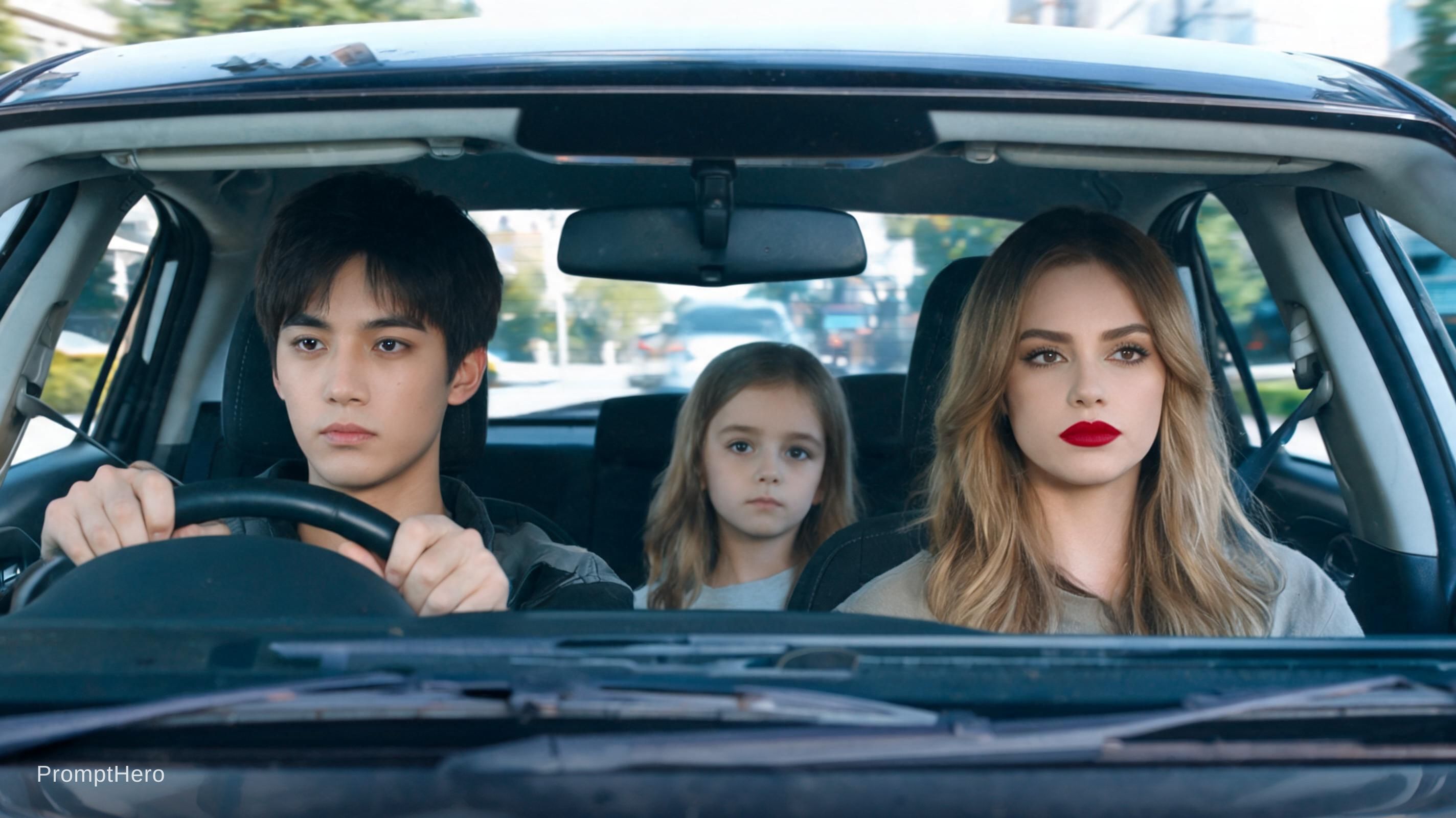
Seedream 5 prompt: 一辆家用小汽车内有三位人物,男性坐在驾驶位上,背景为移动的汽车,视角从前挡风玻璃往车内视角,可以看到... Nicht angegeben v2
ChatGPT Image prompt: Sport stil Nicht angegeben gpt-image-2.6-flare
Seedream 5 prompt: Have the man put his arm around the woman's should Nicht angegeben seedream-5-pro
Hunyuan  prompt: póster/imagen Nicht angegeben hunyuan-3
Seedream 5 prompt: Conductor Nicht angegeben v2

Führen Sie diese Eingabeaufforderung mit der API aus

Die folgende Anforderung sendet diese Eingabeaufforderung mit den ausgefüllten Standardwerten an das erste Modell, auf dem sie ausgeführt wird. Tauschen Sie den Modellnamen gegen ein anderes oben aufgeführtes Modell aus.

Prompt API-Dokumente
/api/v1/gpt_image_2/text_to_image
curl -X POST https://runapi.ai/api/v1/gpt_image_2/text_to_image \
  -H "Authorization: Bearer $RUNAPI_API_KEY" \
  -H "Content-Type: application/json" \
  --data-binary @- <<'JSON'
{
  "model": "gpt-image-2",
  "prompt": "Goal: Create a detailed Japanese-style illustrated reference sheet infographic titled 雨の日シチュの用語表, explaining useful rainy-day scene vocabulary for AI illustration prompts.\n\nCanvas: Portrait 3:4 poster, aged cream watercolor paper with ink stains, tape, paperclips, torn memo scraps, tiny stars, raindrop doodles, umbrella doodles, and purple hydrangea decorations in the corners. Use a handmade scrapbook notebook aesthetic with thin navy divider lines and slightly worn edges.\n\nOverall visual style: Soft anime watercolor and ink wash, melancholic rainy atmosphere, muted navy, gray, lavender, and beige palette. The recurring subject is a black-haired anime girl in a dark raincoat, usually wet from rain, carrying or standing under a transparent or black umbrella. Add reflective wet streets, mist, puddles, raindrops on glass, and blurred city lights. Keep the text dense but neatly organized like a prompt-writing cheat sheet.\n\nHeader: Large centered brush-calligraphy Japanese headline using the headline text. Under it, add a smaller Japanese subtitle line explaining that the sheet organizes rain, rainy season, puddles, and road-reflection words for AI illustration prompt support. Place a large decorative character portrait at the upper left with hydrangeas; the face area is covered by a soft square blur, matching the generated look. At the upper right, add small taped memo papers and a decorative umbrella sketch.\n\nMain layout: A grid of exactly 24 numbered vocabulary cards, arranged 4 columns by 6 rows. Each card has a dark blue circular number badge, a bold Japanese term title, two or three short Japanese explanatory text lines, and a small anime rainy-scene thumbnail. Use thin navy borders and off-white card backgrounds. Count and label the 24 cards as follows, with these visible concepts: 1 umbrella, 2 shared umbrella, 3 transparent umbrella, 4 wet hair, 5 wet school uniform, 6 rain lodging or taking shelter from rain, 7 under the eaves, 8 bus stop, 9 rain in front of the station, 10 sudden shower, 11 rain inside a train car, 12 window glass, 13 puddle, 14 road surface reflection, 15 raindrops, 16 misty rain, 17 muddy ground, 18 cloudy sky, 19 gray sky, 20 after the rain, 21 night rain, 22 neon reflections, 23 rainy-season humidity, 24 rainy-day aftermath.\n\nThumbnail details: Vary every card image while keeping the same rainy anime mood. Include close-up portraits, walking scenes, umbrellas, wet clothes, bus stop, station crowd, train window, puddle reflection, neon city street, hydrangea after rain, and rainy room or alley aftermath. Cards 10 and 11 should include soft gray square blurs over part of the character face area, echoing the original censored-looking artifacts.\n\nBottom section: Add a wide bordered note panel titled in Japanese as a usage guide, with exactly 5 bullet points in small Japanese text explaining how to use the vocabulary list for AI illustration prompts. Decorate the bottom with washi tape, a fountain pen ink bottle, scattered clips, handwritten memo scraps, small flowers, and tiny rain icons.\n\nConstraints: The final image must feel like an information-dense printable reference sheet, not a single illustration. Use exactly 24 numbered cards and exactly 5 bottom bullet points. Keep the Japanese calligraphy headline prominent, maintain legible grid structure, and avoid adding logos or watermarks."
}
JSON

Probier‘s mal mit einer Anfrage

Geschätzt: $0.04 / Bild

Zum Generieren mit RunAPI einloggen.

Anmelden zum Generieren

Melde dich an, um mit deinen verfügbaren Sprachmodellen zu beginnen.