LEO Rocket Delta-V Infographic

Generates a Japanese engineering infographic explaining why reaching low Earth orbit is the hardest and most expensive part of a rocket mission.
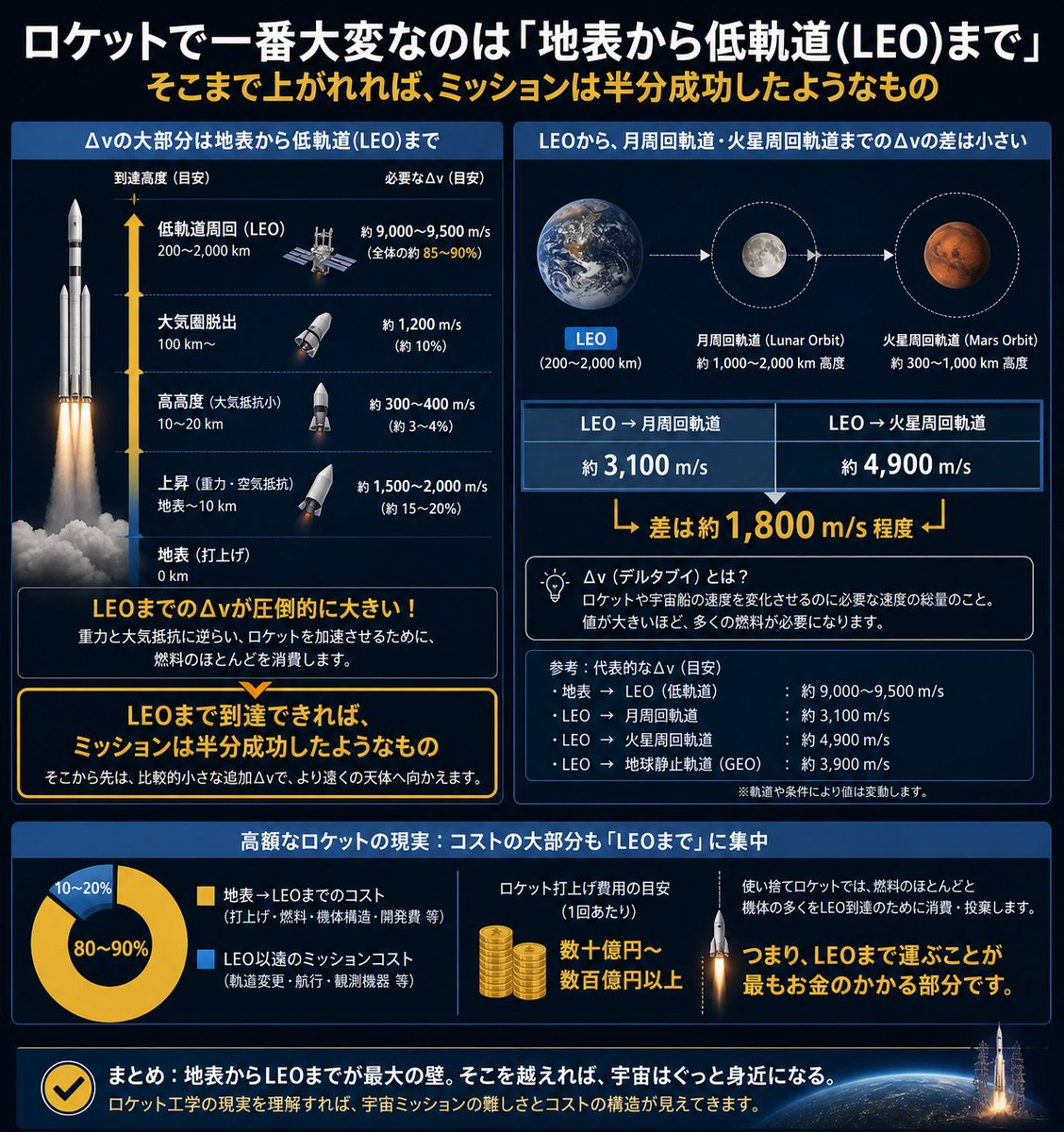
LEO Rocket Delta-V Infographic

翻訳: Prompt

{ "type": "Japanese rocket engineering infographic", "format": "single square educational infographic, 1:1 aspect ratio", "theme": "explain that the hardest part of a rocket mission is getting from Earth's surface to low Earth orbit, based on basic rocket engineering", "language": "Japanese", "visual style": "dark navy space-tech infographic with bright blue section headers, yellow-orange highlights, white Japanese typography, clean engineering diagrams, realistic 3D rocket and planet renders, high contrast, polished social media explainer design", "headline": "ロケットで一番大変なのは「地表から低軌道(LEO)まで」", "subtitle": "そこまで上がれれば、ミッションは半分成功したようなもの", "canvas": { "background": "deep navy gradient with subtle grid lines and space atmosphere glow", "border": "thin blue outline around the full infographic", "layout": "top headline, two large upper panels side by side, a wide middle cost panel, and a bottom summary banner" }, "layout": { "sections count": 5, "sections": [ { "title": "Δvの大部分は地表から低軌道(LEO)まで", "position": "upper left", "content type": "vertical altitude and delta-v comparison chart with rocket launch illustration", "main visual": "large white-and-black heavy rocket lifting off at far left with bright orange flames and smoke cloud", "chart columns": ["到達高度(目安)", "必要なΔv(目安)"], "altitude stages count": 4, "altitude stages": [ {"label": "低軌道周回(LEO)", "altitude": "200〜2,000 km", "delta v": "約9,000〜9,500 m/s(全体の約85〜90%)", "icon": "small satellite"}, {"label": "大気圏脱出", "altitude": "100 km〜", "delta v": "約1,200 m/s(約10%)", "icon": "small angled rocket"}, {"label": "高高度(大気抵抗小)", "altitude": "10〜20 km", "delta v": "約300〜400 m/s(約3〜4%)", "icon": "small rocket"}, {"label": "上昇(重力・空気抵抗)", "altitude": "地表〜10 km", "delta v": "約1,500〜2,000 m/s(約15〜20%)", "icon": "small rocket nose-up"} ], "callouts count": 2, "callouts": [ {"text": "LEOまでのΔvが圧倒的に大きい!", "style": "yellow headline inside bordered dark box"}, {"text": "LEOまで到達できれば、ミッションは半分成功したようなもの", "style": "larger orange bordered box with downward arrow"} ] }, { "title": "LEOから、月周回軌道・火星周回軌道までのΔvの差は小さい", "position": "upper right", "content type": "space trajectory comparison diagram and delta-v table", "celestial bodies count": 3, "celestial bodies": [ {"label": "LEO", "description": "Earth with blue atmosphere, dotted circular orbit, label 200〜2,000 km"}, {"label": "月周回軌道(Lunar Orbit)", "description": "gray Moon in dotted orbit, label 約1,000〜2,000 km 高度"}, {"label": "火星周回軌道(Mars Orbit)", "description": "orange Mars in dotted orbit, label 約300〜1,000 km 高度"} ], "trajectory arrows count": 2, "trajectory arrows": ["Earth/LEO to Moon", "Moon to Mars"], "comparison boxes count": 2, "comparison boxes": [ {"label": "LEO → 月周回軌道", "value": "約3,100 m/s"}, {"label": "LEO → 火星周回軌道", "value": "約4,900 m/s"} ], "highlight": "差は約1,800 m/s程度", "definition box": { "title": "Δv(デルタブイ)とは?", "text": "ロケットや宇宙船の速度を変化させるのに必要な速度の総量のこと。値が大きいほど、多くの燃料が必要になります。", "icon": "light bulb" }, "reference list count": 4, "reference list": [ "地表 → LEO(低軌道): 約9,000〜9,500 m/s", "LEO → 月周回軌道: 約3,100 m/s", "LEO → 火星周回軌道: 約4,900 m/s", "LEO → 地球静止軌道(GEO): 約3,900 m/s" ], "footnote": "※燃費や条件により値は変動します。" }, { "title": "高額なロケットの現実:コストの大部分も「LEOまで」に集中", "position": "middle full width", "content type": "cost breakdown panel", "subcomponents count": 4, "subcomponents": [ {"type": "donut chart", "label": "80〜90%", "secondary label": "10〜20%", "colors": "yellow and blue"}, {"type": "legend", "items count": 2, "items": ["地表→LEOまでのコスト(打上げ・燃料・機体構造・開発費 等)", "LEO以遠のミッションコスト(軌道変更・航行・観測機器 等)"]}, {"type": "coin stack illustration", "label": "ロケット打上げ費用の目安(1回あたり)", "value": "数十億円〜数百億円以上"}, {"type": "small rocket launch icon and explanatory text", "text": "使い捨てロケットでは、燃料のほとんど、機体の多くをLEO到達のために消費・投棄します。つまり、LEOまで運ぶことが最もお金のかかる部分です。"} ] }, { "title": "まとめ:地表からLEOまでが最大の壁。そこを越えれば、宇宙はぐっと身近になる。", "position": "bottom full width", "content type": "summary banner", "icon": "large yellow checkmark in circle at left", "background visual": "curved Earth horizon and small rocket launch at right", "body text": "ロケット工学の現実を理解すれば、宇宙ミッションの難しさとコストの構造が見えてきます。" }, { "title": "overall visual accents", "position": "throughout", "content type": "decorative technical elements", "items count": 5, "items": ["blue panel headers", "orange arrows", "thin divider lines", "small spacecraft icons", "glowing yellow emphasis text"] } ] }, "typography": { "headline": "large bold white Japanese sans-serif with quoted LEO phrase", "subtitle": "bold yellow Japanese sans-serif", "body": "compact clean white Japanese text", "numbers": "large bold white and yellow numerals for delta-v values" }, "color palette": { "primary background": "deep navy blue", "accent": "golden yellow-orange", "secondary": "electric blue", "text": "white" }, "rendering instructions": "Create a crisp, readable, information-dense Japanese infographic suitable for X/Twitter. Keep all labels sharp and legible, align panels cleanly, preserve the exact Japanese text where specified, use realistic rocket/planet illustrations mixed with flat UI-style charts, and avoid clutter outside the structured panels." }

翻訳: Runs on 18 models

  • Flux
  • Flux 2
  • Flux Kontext
  • GPT-4o Image
  • GPT Image
  • GPT Image 2
  • GPT Image 2.5
  • Grok Imagine
  • Ideogram V3
  • Imagen 4
  • Midjourney
  • Nano Banana
  • 翻訳: +6 more

このプロンプトの生成結果

Realistic Group Selfie with Smartphone Flash Effect 未指定 nano-banana-pro
Four Seasons Portrait Collage 未指定 nano-banana-pro
Minimalist Dog Sketch Clipart 未指定 nano-banana-pro
Mecha Girl figure concept generated by Nano Banana Pro 未指定 nano-banana-pro
Candid Flash Photography: Chaotic Holiday Party (Duplicate) 未指定 nano-banana-pro
Ethereal Floral Studio Portrait 未指定 nano-banana-pro

翻訳: Run this prompt with the API

翻訳: The request below sends this prompt, with its default values filled in, to the first model it runs on. Swap the model name for any other model listed above.

翻訳: Prompt API docs
/api/v1/gpt_image_2/text_to_image
curl -X POST https://runapi.ai/api/v1/gpt_image_2/text_to_image \
  -H "Authorization: Bearer $RUNAPI_API_KEY" \
  -H "Content-Type: application/json" \
  --data-binary @- <<'JSON'
{
  "model": "gpt-image-2",
  "prompt": "{\n  \"type\": \"Japanese rocket engineering infographic\",\n  \"format\": \"single square educational infographic, 1:1 aspect ratio\",\n  \"theme\": \"explain that the hardest part of a rocket mission is getting from Earth's surface to low Earth orbit, based on basic rocket engineering\",\n  \"language\": \"Japanese\",\n  \"visual style\": \"dark navy space-tech infographic with bright blue section headers, yellow-orange highlights, white Japanese typography, clean engineering diagrams, realistic 3D rocket and planet renders, high contrast, polished social media explainer design\",\n  \"headline\": \"ロケットで一番大変なのは「地表から低軌道(LEO)まで」\",\n  \"subtitle\": \"そこまで上がれれば、ミッションは半分成功したようなもの\",\n  \"canvas\": {\n    \"background\": \"deep navy gradient with subtle grid lines and space atmosphere glow\",\n    \"border\": \"thin blue outline around the full infographic\",\n    \"layout\": \"top headline, two large upper panels side by side, a wide middle cost panel, and a bottom summary banner\"\n  },\n  \"layout\": {\n    \"sections count\": 5,\n    \"sections\": [\n      {\n        \"title\": \"Δvの大部分は地表から低軌道(LEO)まで\",\n        \"position\": \"upper left\",\n        \"content type\": \"vertical altitude and delta-v comparison chart with rocket launch illustration\",\n        \"main visual\": \"large white-and-black heavy rocket lifting off at far left with bright orange flames and smoke cloud\",\n        \"chart columns\": [\"到達高度(目安)\", \"必要なΔv(目安)\"],\n        \"altitude stages count\": 4,\n        \"altitude stages\": [\n          {\"label\": \"低軌道周回(LEO)\", \"altitude\": \"200〜2,000 km\", \"delta v\": \"約9,000〜9,500 m/s(全体の約85〜90%)\", \"icon\": \"small satellite\"},\n          {\"label\": \"大気圏脱出\", \"altitude\": \"100 km〜\", \"delta v\": \"約1,200 m/s(約10%)\", \"icon\": \"small angled rocket\"},\n          {\"label\": \"高高度(大気抵抗小)\", \"altitude\": \"10〜20 km\", \"delta v\": \"約300〜400 m/s(約3〜4%)\", \"icon\": \"small rocket\"},\n          {\"label\": \"上昇(重力・空気抵抗)\", \"altitude\": \"地表〜10 km\", \"delta v\": \"約1,500〜2,000 m/s(約15〜20%)\", \"icon\": \"small rocket nose-up\"}\n        ],\n        \"callouts count\": 2,\n        \"callouts\": [\n          {\"text\": \"LEOまでのΔvが圧倒的に大きい!\", \"style\": \"yellow headline inside bordered dark box\"},\n          {\"text\": \"LEOまで到達できれば、ミッションは半分成功したようなもの\", \"style\": \"larger orange bordered box with downward arrow\"}\n        ]\n      },\n      {\n        \"title\": \"LEOから、月周回軌道・火星周回軌道までのΔvの差は小さい\",\n        \"position\": \"upper right\",\n        \"content type\": \"space trajectory comparison diagram and delta-v table\",\n        \"celestial bodies count\": 3,\n        \"celestial bodies\": [\n          {\"label\": \"LEO\", \"description\": \"Earth with blue atmosphere, dotted circular orbit, label 200〜2,000 km\"},\n          {\"label\": \"月周回軌道(Lunar Orbit)\", \"description\": \"gray Moon in dotted orbit, label 約1,000〜2,000 km 高度\"},\n          {\"label\": \"火星周回軌道(Mars Orbit)\", \"description\": \"orange Mars in dotted orbit, label 約300〜1,000 km 高度\"}\n        ],\n        \"trajectory arrows count\": 2,\n        \"trajectory arrows\": [\"Earth/LEO to Moon\", \"Moon to Mars\"],\n        \"comparison boxes count\": 2,\n        \"comparison boxes\": [\n          {\"label\": \"LEO → 月周回軌道\", \"value\": \"約3,100 m/s\"},\n          {\"label\": \"LEO → 火星周回軌道\", \"value\": \"約4,900 m/s\"}\n        ],\n        \"highlight\": \"差は約1,800 m/s程度\",\n        \"definition box\": {\n          \"title\": \"Δv(デルタブイ)とは?\",\n          \"text\": \"ロケットや宇宙船の速度を変化させるのに必要な速度の総量のこと。値が大きいほど、多くの燃料が必要になります。\",\n          \"icon\": \"light bulb\"\n        },\n        \"reference list count\": 4,\n        \"reference list\": [\n          \"地表 → LEO(低軌道): 約9,000〜9,500 m/s\",\n          \"LEO → 月周回軌道: 約3,100 m/s\",\n          \"LEO → 火星周回軌道: 約4,900 m/s\",\n          \"LEO → 地球静止軌道(GEO): 約3,900 m/s\"\n        ],\n        \"footnote\": \"※燃費や条件により値は変動します。\"\n      },\n      {\n        \"title\": \"高額なロケットの現実:コストの大部分も「LEOまで」に集中\",\n        \"position\": \"middle full width\",\n        \"content type\": \"cost breakdown panel\",\n        \"subcomponents count\": 4,\n        \"subcomponents\": [\n          {\"type\": \"donut chart\", \"label\": \"80〜90%\", \"secondary label\": \"10〜20%\", \"colors\": \"yellow and blue\"},\n          {\"type\": \"legend\", \"items count\": 2, \"items\": [\"地表→LEOまでのコスト(打上げ・燃料・機体構造・開発費 等)\", \"LEO以遠のミッションコスト(軌道変更・航行・観測機器 等)\"]},\n          {\"type\": \"coin stack illustration\", \"label\": \"ロケット打上げ費用の目安(1回あたり)\", \"value\": \"数十億円〜数百億円以上\"},\n          {\"type\": \"small rocket launch icon and explanatory text\", \"text\": \"使い捨てロケットでは、燃料のほとんど、機体の多くをLEO到達のために消費・投棄します。つまり、LEOまで運ぶことが最もお金のかかる部分です。\"}\n        ]\n      },\n      {\n        \"title\": \"まとめ:地表からLEOまでが最大の壁。そこを越えれば、宇宙はぐっと身近になる。\",\n        \"position\": \"bottom full width\",\n        \"content type\": \"summary banner\",\n        \"icon\": \"large yellow checkmark in circle at left\",\n        \"background visual\": \"curved Earth horizon and small rocket launch at right\",\n        \"body text\": \"ロケット工学の現実を理解すれば、宇宙ミッションの難しさとコストの構造が見えてきます。\"\n      },\n      {\n        \"title\": \"overall visual accents\",\n        \"position\": \"throughout\",\n        \"content type\": \"decorative technical elements\",\n        \"items count\": 5,\n        \"items\": [\"blue panel headers\", \"orange arrows\", \"thin divider lines\", \"small spacecraft icons\", \"glowing yellow emphasis text\"]\n      }\n    ]\n  },\n  \"typography\": {\n    \"headline\": \"large bold white Japanese sans-serif with quoted LEO phrase\",\n    \"subtitle\": \"bold yellow Japanese sans-serif\",\n    \"body\": \"compact clean white Japanese text\",\n    \"numbers\": \"large bold white and yellow numerals for delta-v values\"\n  },\n  \"color palette\": {\n    \"primary background\": \"deep navy blue\",\n    \"accent\": \"golden yellow-orange\",\n    \"secondary\": \"electric blue\",\n    \"text\": \"white\"\n  },\n  \"rendering instructions\": \"Create a crisp, readable, information-dense Japanese infographic suitable for X/Twitter. Keep all labels sharp and legible, align panels cleanly, preserve the exact Japanese text where specified, use realistic rocket/planet illustrations mixed with flat UI-style charts, and avoid clutter outside the structured panels.\"\n}"
}
JSON

翻訳: Try a prompt

概算: $0.04 / 枚

RunAPI で生成するにはサインインしてください。

ログインして生成

ログインして、利用可能な言語モデルで生成を開始してください。