Earth Cutaway Layer Infographic
Earth Cutaway Layer Infographic

prompt

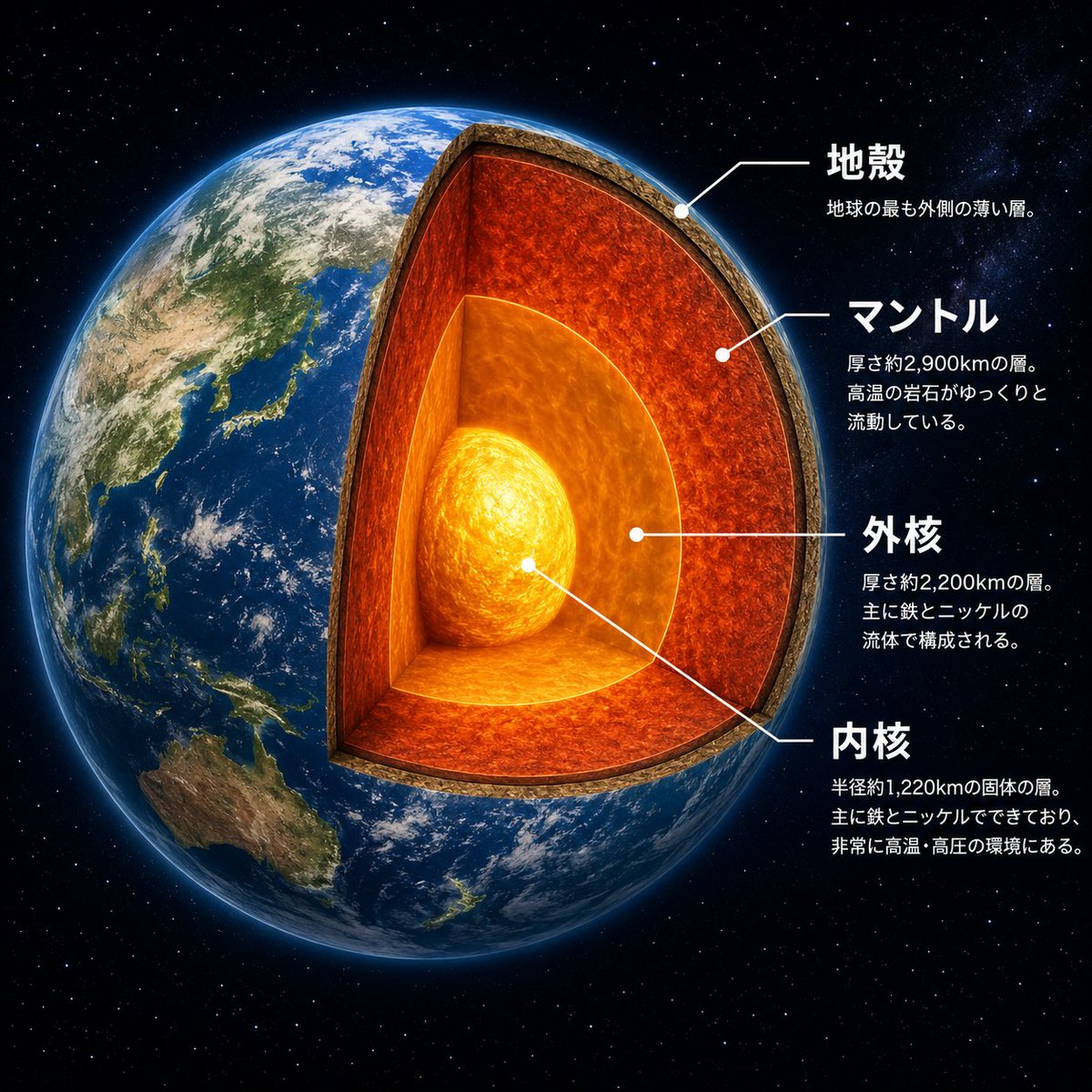
Goal: Create a dramatic scientific cutaway infographic of Earth, showing the planet in space with its internal layers exposed like a precise 3D sectional model. Canvas: Square 1:1 composition, high-resolution, black star-filled space background. The planet fills most of the left and center of the frame, with annotation text arranged on the right side. Main subject: A photorealistic Earth viewed from space, centered slightly left, with Asia, Japan, Southeast Asia, and Australia visible on the surface. Remove a large wedge-shaped quarter section from the front-right side of the globe to reveal the interior. The cutaway should look physically carved, with a thick rocky crust rim and glowing internal layers. Add a subtle blue atmospheric glow around the planet. Cutaway structure: Show exactly 4 discrete internal/structural layers, each visually distinct and aligned with annotation leader lines: 1) a thin brown rocky crust at the outer edge, 2) a thick red-orange molten mantle layer with turbulent texture, 3) a bright orange outer core surrounding the center, and 4) a glowing yellow-white inner core sphere at the center. Make the mantle the largest visible layer, the outer core semi-spherical and luminous, and the inner core intensely bright with swirling heat texture. Text and labels: Place exactly 4 Japanese annotation blocks on the right, each with a white dot marker and thin white leader line pointing to the correct layer. Use bold white Japanese headings and smaller white explanatory text beneath each heading. The four visible labels must be: 地殻 with smaller text “地球の最も外側の薄い層。”; マントル with smaller text “厚さ約2,900kmの層。高温の岩石がゆっくりと流動している。”; 外核 with smaller text “厚さ約2,200kmの層。主に鉄とニッケルの流体で構成される。”; 内核 with smaller text “半径約1,220kmの固体の層。主に鉄とニッケルでできており、非常に高温・高圧の環境にある。” Visual style: Photorealistic space-science educational poster, cinematic lighting, crisp typography, realistic Earth texture, glowing lava-like interior, clean white callout lines, high contrast, polished museum infographic style. Constraints: Keep exactly 4 annotation blocks and exactly 4 layer labels. Do not add extra icons, extra labels, borders, logos, watermarks, or decorative UI panels. Keep all text legible and positioned to the right of the planet.

Funciona em 21 modelos

  • Flux
  • Flux 2
  • Flux Kontext
  • GPT-4o Image
  • GPT Image
  • GPT Image 2
  • GPT Image 2.5
  • GPT Image 2.6
  • Grok Imagine
  • Ideogram V3
  • Imagen 4
  • Kling
  • +9 Mais

O que este prompt produz

Hunyuan  prompt: feet Não especificado hunyuan-3
Hunyuan  prompt: Bathroom Não especificado hunyuan-3
Nano Banana prompt: She is wearing this outfit(white top ) given in im... Não especificado nano-banana-2.1
Seedream 5 prompt: woman Não especificado v2
Hero prompt: مع رجل اسود على شاطى البحر Não especificado 1.0
FLUX prompt: می‌خوام برام یک مداد طلایی ته بنفش تیره رو که داره... Não especificado flux-2-pro

Run este prompt com o API

A solicitação abaixo envia esse prompt, com seus valores padrão preenchidos, para o primeiro modelo em que é executado. Troque o nome do modelo por qualquer outro modelo listado acima.

Documentação da prompt API
/api/v1/gpt_image_2/text_to_image
curl -X POST https://runapi.ai/api/v1/gpt_image_2/text_to_image \
  -H "Authorization: Bearer $RUNAPI_API_KEY" \
  -H "Content-Type: application/json" \
  --data-binary @- <<'JSON'
{
  "model": "gpt-image-2",
  "prompt": "Goal: Create a dramatic scientific cutaway infographic of Earth, showing the planet in space with its internal layers exposed like a precise 3D sectional model.\n\nCanvas: Square 1:1 composition, high-resolution, black star-filled space background. The planet fills most of the left and center of the frame, with annotation text arranged on the right side.\n\nMain subject: A photorealistic Earth viewed from space, centered slightly left, with Asia, Japan, Southeast Asia, and Australia visible on the surface. Remove a large wedge-shaped quarter section from the front-right side of the globe to reveal the interior. The cutaway should look physically carved, with a thick rocky crust rim and glowing internal layers. Add a subtle blue atmospheric glow around the planet.\n\nCutaway structure: Show exactly 4 discrete internal/structural layers, each visually distinct and aligned with annotation leader lines: 1) a thin brown rocky crust at the outer edge, 2) a thick red-orange molten mantle layer with turbulent texture, 3) a bright orange outer core surrounding the center, and 4) a glowing yellow-white inner core sphere at the center. Make the mantle the largest visible layer, the outer core semi-spherical and luminous, and the inner core intensely bright with swirling heat texture.\n\nText and labels: Place exactly 4 Japanese annotation blocks on the right, each with a white dot marker and thin white leader line pointing to the correct layer. Use bold white Japanese headings and smaller white explanatory text beneath each heading. The four visible labels must be: 地殻 with smaller text “地球の最も外側の薄い層。”; マントル with smaller text “厚さ約2,900kmの層。高温の岩石がゆっくりと流動している。”; 外核 with smaller text “厚さ約2,200kmの層。主に鉄とニッケルの流体で構成される。”; 内核 with smaller text “半径約1,220kmの固体の層。主に鉄とニッケルでできており、非常に高温・高圧の環境にある。”\n\nVisual style: Photorealistic space-science educational poster, cinematic lighting, crisp typography, realistic Earth texture, glowing lava-like interior, clean white callout lines, high contrast, polished museum infographic style.\n\nConstraints: Keep exactly 4 annotation blocks and exactly 4 layer labels. Do not add extra icons, extra labels, borders, logos, watermarks, or decorative UI panels. Keep all text legible and positioned to the right of the planet."
}
JSON

Experimentar a prompt