Split-Era Urban Diorama Generation Prompt for Nano Banana Pro

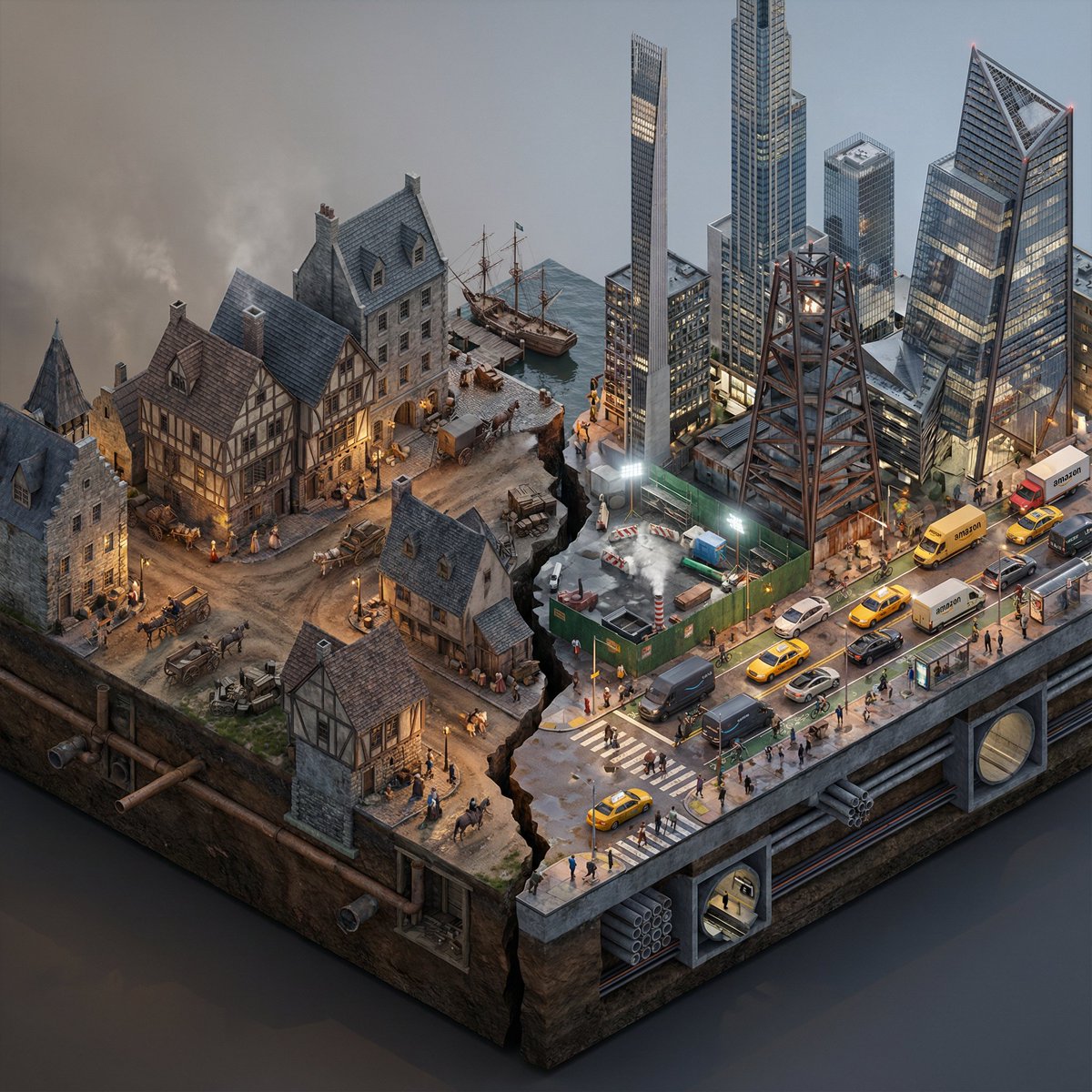
This is a highly detailed, multi-section system instruction designed for the Nano Banana Pro model to generate a photorealistic, isometric macro render of a split-era urban diorama. The prompt focuses on achieving Historical and Municipal Accuracy by contrasting two different time periods within the same city block, specifically detailing architectural styles, urban clutter, lighting, and composition for a realistic comparison.
Split-Era Urban Diorama Generation Prompt for Nano Banana Pro

prompt

Do this for New York 1700 vs New York 2025 <instructions> Input Variable: [City/Year A vs. City/Year B] (e.g., New York 1900 vs. New York 2025) System Instruction: Generate a photorealistic, isometric macro render of a split-era urban diorama. The goal is Historical and Municipal Accuracy, avoiding sci-fi tropes or idealization. 1. Temporal Forensic Analysis: Analyze the Dates: Strictly adhere to the architectural technologies available in Year A versus Year B. The Left Block (The Past): Construct the Left side using the dominant vernacular of the era. For 1900: Beaux-Arts stone, brick tenements, water towers, external fire escapes, and cobblestone/early asphalt. The Right Block (The Present/Future): Construct the Right side using current urban realities, not futuristic fantasies. For 2025: Prioritize "Super-Slender" Pencil Towers (Billionaire's Row style), Glass Curtain Walls mixed with preserved older facades, and "Hudson Yards" style angled steel. Crucial Detail: If the year is modern (2020+), you MUST include Urban Clutter: Green construction plywood barriers, sidewalk scaffolding (sheds), steam vents, and delivery trucks. 2. The Container (The Cross-Section): The Base: Two suspended chunks of city infrastructure, revealing the "Underground" layer on the side profile. Left Underground: Brick sewers and early subway tunnels. Right Underground: Concrete conduit banks, fiber optic lines, and modern subway tiles. The Divider: A jagged timeline fracture. No glowing sci-fi energy. The divide is a stark cut in the asphalt. 3. The Composition (The Density): Left Street Life: Period-accurate transport (Horse-drawn carriages mixed with early Model T Fords or Trolleys). Pedestrians in dark coats/hats. Right Street Life: Municipal Realism. Yellow Taxis, Amazon delivery vans, Uber cars, and bike lanes with cyclists. The street level should feel congested and chaotic. Vegetation: Left has Elm trees (if applicable); Right has manicured "Corporate Plaza" planters and rooftop gardens. 4. Accurate Lighting Simulation (No "Neon Filters"): Left Lighting: Carbon-Arc and Gaslight. The light should be dim, patchy, and warm (2400K), casting long shadows. Right Lighting: Mixed Municipal Lighting. A chaotic mix of warm sodium streetlights (orange), harsh white LED construction lights (6000K), and internal office lighting (neutral). Do not use "Cyberpunk Blue" or "Purple" unless it is a specific billboard. Atmosphere: The Left is hazy from coal smoke. The Right has a clearer, sharper air quality but with light pollution. 5. Visual Syntax: Camera: Isometric Orthographic projection, 45-degree angle. Render Style: Photorealistic Architectural Visualization (ArchViz), 8k, V-Ray Render. Focus on texture fidelity (rust, wet pavement, grime) rather than bloom effects. Output: 1:1 Aspect Ratio, Extreme Detail, Historically Authentic.

Działa z 20 modelami

  • Flux
  • Flux 2
  • Flux Kontext
  • GPT-4o Image
  • GPT Image
  • GPT Image 2
  • GPT Image 2.5
  • GPT Image 2.6
  • Grok Imagine
  • Ideogram V3
  • Imagen 4
  • Kling
  • +8 Więcej

Wynik tego promptu

Split-Page Coffee Shop Travel Journal Nie określono gpt-image-2
Cute Chibi Characters in a Sweet Playful Moment Nie określono gpt-image-2
Underground Train Yard Clash Anime Development Board Nie określono gpt-image-2
Realistic Group Selfie with Smartphone Flash Effect Nie określono nano-banana-pro
Exploded-View Structural Cutaway for Food Photography Nie określono nano-banana-pro
Four Seasons Portrait Collage Nie określono nano-banana-pro

Run ten prompt z ten API

Poniższe żądanie wysyła ten monit z wypełnionymi wartościami domyślnymi do pierwszego modelu, na którym działa. Zamień nazwę modelu na dowolny inny model wymieniony powyżej.

Dokumentacja prompt API
/api/v1/nano_banana/text_to_image
curl -X POST https://runapi.ai/api/v1/nano_banana/text_to_image \
  -H "Authorization: Bearer $RUNAPI_API_KEY" \
  -H "Content-Type: application/json" \
  --data-binary @- <<'JSON'
{
  "model": "nano-banana-pro",
  "prompt": "Do this for New York 1700 vs New York 2025\n\n<instructions>\nInput Variable: [City/Year A vs. City/Year B] (e.g., New York 1900 vs. New York 2025)\n\nSystem Instruction:\nGenerate a photorealistic, isometric macro render of a split-era urban diorama. The goal is Historical and Municipal Accuracy, avoiding sci-fi tropes or idealization.\n\n1. Temporal Forensic Analysis:\nAnalyze the Dates:\n Strictly adhere to the architectural technologies available in Year A versus Year B.\nThe Left Block (The Past): Construct the Left side using the dominant vernacular of the era.\nFor 1900: Beaux-Arts stone, brick tenements, water towers, external fire escapes, and cobblestone/early asphalt.\nThe Right Block (The Present/Future): Construct the Right side using current urban realities, not futuristic fantasies.\nFor 2025: Prioritize \"Super-Slender\" Pencil Towers (Billionaire's Row style), Glass Curtain Walls mixed with preserved older facades, and \"Hudson Yards\" style angled steel.\n  Crucial Detail: If the year is modern (2020+), you MUST include Urban Clutter: Green construction plywood barriers, sidewalk scaffolding (sheds), steam vents, and delivery trucks.\n\n2. The Container (The Cross-Section):\nThe Base: Two suspended chunks of city infrastructure, revealing the \"Underground\" layer on the side profile.\nLeft Underground: Brick sewers and early subway tunnels.\nRight Underground: Concrete conduit banks, fiber optic lines, and modern subway tiles.\nThe Divider: A jagged timeline fracture. No glowing sci-fi energy. The divide is a stark cut in the asphalt.\n\n3. The Composition (The Density):\nLeft Street Life: Period-accurate transport (Horse-drawn carriages mixed with early Model T Fords or Trolleys). Pedestrians in dark coats/hats.\nRight Street Life: Municipal Realism. Yellow Taxis, Amazon delivery vans, Uber cars, and bike lanes with cyclists. The street level should feel congested and chaotic.\nVegetation: Left has Elm trees (if applicable); Right has manicured \"Corporate Plaza\" planters and rooftop gardens.\n\n4. Accurate Lighting Simulation (No \"Neon Filters\"):\nLeft Lighting: Carbon-Arc and Gaslight. The light should be dim, patchy, and warm (2400K), casting long shadows.\n Right Lighting: Mixed Municipal Lighting. A chaotic mix of warm sodium streetlights (orange), harsh white LED construction lights (6000K), and internal office lighting (neutral). Do not use \"Cyberpunk Blue\" or \"Purple\" unless it is a specific billboard.\nAtmosphere: The Left is hazy from coal smoke. The Right has a clearer, sharper air quality but with light pollution.\n\n5. Visual Syntax:\nCamera: Isometric Orthographic projection, 45-degree angle.\nRender Style: Photorealistic Architectural Visualization (ArchViz), 8k, V-Ray Render. Focus on texture fidelity (rust, wet pavement, grime) rather than bloom effects.\n\nOutput: 1:1 Aspect Ratio, Extreme Detail, Historically Authentic."
}
JSON

Wypróbuj a prompt

Szacunkowo: $0.04 / obraz

Zaloguj się, aby generować przez RunAPI.

Zaloguj się, aby generować

Zaloguj się, aby rozpocząć generowanie z dostępnymi modelami językowymi.