Apollo 11 Mission Control DV Camcorder Footage

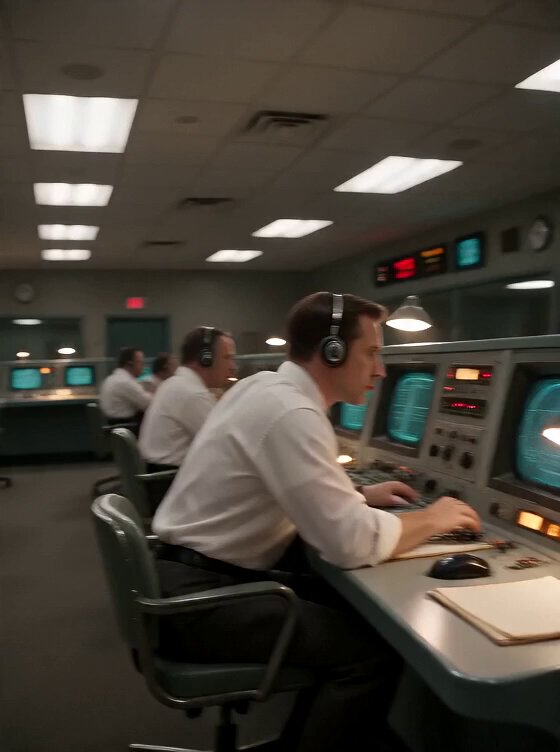
A handheld documentary style prompt simulating early-2000s DV camcorder footage of NASA Mission Control during the moon landing, including a transition to the lunar surface.
Apollo 11 Mission Control DV Camcorder Footage

Prompt

This is handheld documentary footage recorded on an early-2000s consumer DV camcorder by someone moving through NASA Mission Control in Houston during the Apollo 11 moon landing, July 20, 1969. The footage feels like real, imperfect home video, captured in quick, energetic bursts as the camera operator moves through the room chasing the action. The recording opens weaving fast between rows of consoles, engineers leaning into their screens, hands flying across switches and dials. The camera cuts and whips between different stations: one engineer pounding a fist lightly on the desk in tense anticipation, another leaning back rubbing his eyes, a cluster of three men huddled around a single console pointing at data readouts. Headsets crackle, papers shuffle, someone stands up abruptly and the camera swings to follow him as he strides toward the front of the room. The camera pushes closer to the huge front display, a grainy black-and-white schematic tracking the lunar module's descent, numbers ticking down. It cuts to a side console screen showing a wavering, static-streaked video feed, distorted with transmission noise, rolling scan lines, and intermittent signal dropout, the faint outline of an astronaut visible through the interference. The room erupts in scattered movement, people standing, leaning in, someone shouting numbers, another slapping a colleague's shoulder. The camera pushes in tight on that noisy screen, the image glitching, static rolling, the picture briefly cutting to black before flickering back. As it pushes closer the transmission noise and scan lines intensify, filling the frame, and then the image resolves outward into full clarity: the camera is no longer looking at a screen at all but is suddenly standing on the lunar surface itself, the horizon curving under a black sky, harsh sunlight casting long shadows across the grey dust, the astronaut now filmed directly, boots kicking up slow-falling regolith with each step. The handheld camera throughout Mission Control shows constant whip-pans, fast walking shake, quick rack-focus misses, autofocus hunting between bright screens and dim room lighting, lens flare from overhead fluorescents, and typical DV camcorder imperfections — grain, motion blur on fast cuts, and audio clipping from raised voices. Once the footage transitions to the lunar surface, the camera motion changes entirely: slow, floating, low-gravity movement, sudden gentle bounces as if the person filming is also moving in reduced gravity, dust hanging oddly in the air, harsh contrast between blinding sunlight and pitch-black shadow, and the same DV grain and imperfections carried over as though it's the same tape. Natural sound only: on Earth, the hum of electronics, overlapping headset chatter, static bursts, shouted numbers, footsteps, and papers rustling; transitioning into muffled radio-static breathing sounds

Runs on 13 models

  • Gemini Omni
  • Grok Imagine
  • Hailuo
  • HappyHorse
  • HeyGen Video
  • Kling
  • LTX Video
  • MiniMax H3
  • PixVerse
  • Runway
  • Seedance
  • Veo 3.1
  • +1 more

What this prompt produces

Continuous Time Journey Cinematic Video Not specified seedance-2.5
Cinematic Samurai Japanese Visuals Not specified grok-imagine
Dark Lava Creature Transformation Prompt Not specified seedance-2.0
Multi-Shot Classroom Action Timeline Not specified seedance-2.0
Hospital Corridor Horror Jumpscare Not specified seedance-2.0
Top-Down Product Zoom Video Prompt Not specified nano-banana-pro

Run this prompt with the API

The request below sends this prompt, with its default values filled in, to the first model it runs on. Swap the model name for any other model listed above.

Prompt API docs
/api/v1/seedance/text_to_video
curl -X POST https://runapi.ai/api/v1/seedance/text_to_video \
  -H "Authorization: Bearer $RUNAPI_API_KEY" \
  -H "Content-Type: application/json" \
  --data-binary @- <<'JSON'
{
  "model": "seedance-2.0",
  "prompt": "This is handheld documentary footage recorded on an early-2000s consumer DV camcorder by someone moving through NASA Mission Control in Houston during the Apollo 11 moon landing, July 20, 1969. The footage feels like real, imperfect home video, captured in quick, energetic bursts as the camera operator moves through the room chasing the action.  The recording opens weaving fast between rows of consoles, engineers leaning into their screens, hands flying across switches and dials. The camera cuts and whips between different stations: one engineer pounding a fist lightly on the desk in tense anticipation, another leaning back rubbing his eyes, a cluster of three men huddled around a single console pointing at data readouts. Headsets crackle, papers shuffle, someone stands up abruptly and the camera swings to follow him as he strides toward the front of the room.  The camera pushes closer to the huge front display, a grainy black-and-white schematic tracking the lunar module's descent, numbers ticking down. It cuts to a side console screen showing a wavering, static-streaked video feed, distorted with transmission noise, rolling scan lines, and intermittent signal dropout, the faint outline of an astronaut visible through the interference. The room erupts in scattered movement, people standing, leaning in, someone shouting numbers, another slapping a colleague's shoulder.  The camera pushes in tight on that noisy screen, the image glitching, static rolling, the picture briefly cutting to black before flickering back. As it pushes closer the transmission noise and scan lines intensify, filling the frame, and then the image resolves outward into full clarity: the camera is no longer looking at a screen at all but is suddenly standing on the lunar surface itself, the horizon curving under a black sky, harsh sunlight casting long shadows across the grey dust, the astronaut now filmed directly, boots kicking up slow-falling regolith with each step.  The handheld camera throughout Mission Control shows constant whip-pans, fast walking shake, quick rack-focus misses, autofocus hunting between bright screens and dim room lighting, lens flare from overhead fluorescents, and typical DV camcorder imperfections — grain, motion blur on fast cuts, and audio clipping from raised voices. Once the footage transitions to the lunar surface, the camera motion changes entirely: slow, floating, low-gravity movement, sudden gentle bounces as if the person filming is also moving in reduced gravity, dust hanging oddly in the air, harsh contrast between blinding sunlight and pitch-black shadow, and the same DV grain and imperfections carried over as though it's the same tape.  Natural sound only: on Earth, the hum of electronics, overlapping headset chatter, static bursts, shouted numbers, footsteps, and papers rustling; transitioning into muffled radio-static breathing sounds"
}
JSON

Try a prompt

Estimated: $0.24 / second

Sign in to generate with RunAPI.

Sign in to generate

Sign in to start generating with your available language models.