Handwritten Data Structures Homework Photo

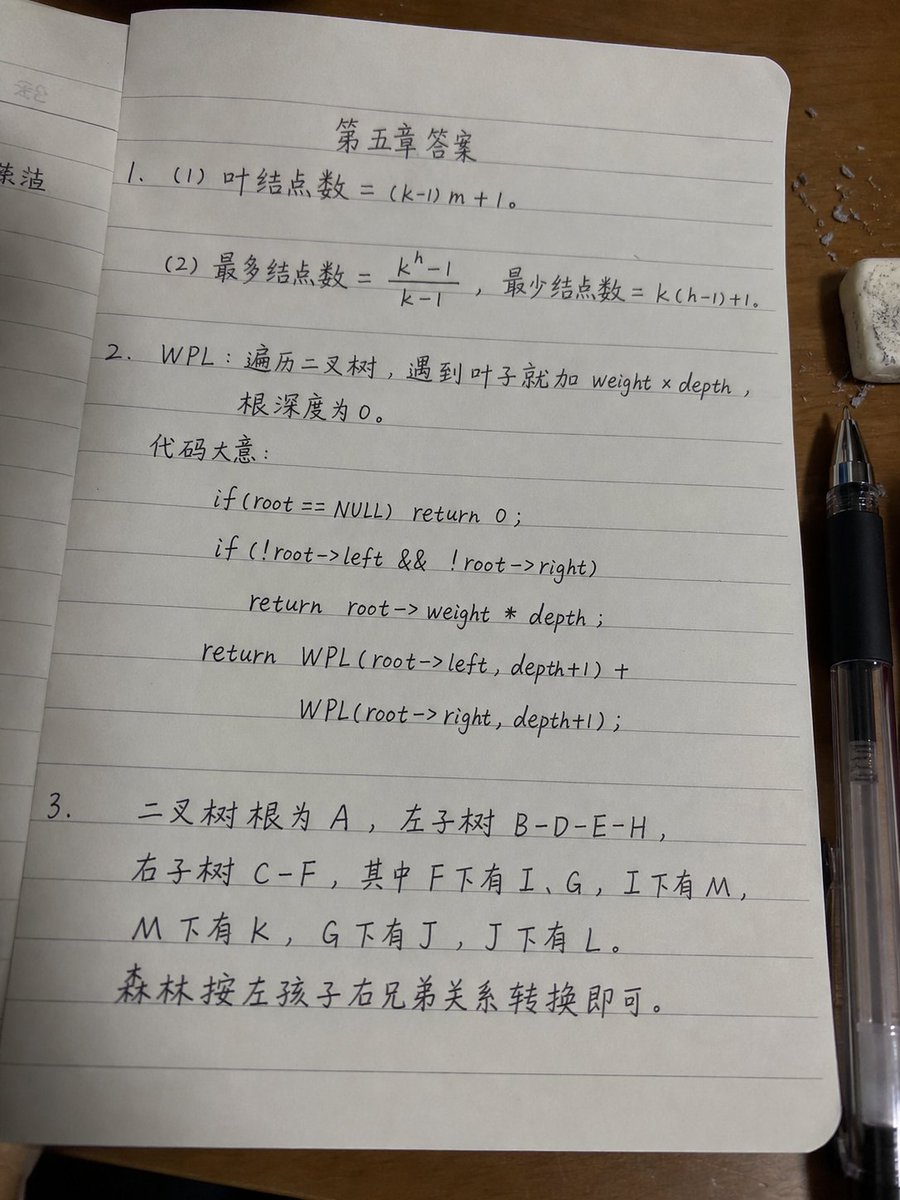
Generates a realistic phone photo of a lined notebook page containing handwritten Chinese data-structures homework answers for a class submission.
Handwritten Data Structures Homework Photo

Prompt

Goal: Create a realistic smartphone photo of a lined notebook page on a wooden desk, showing a handwritten software/data-structure homework answer sheet in slightly messy but believable black gel-pen handwriting. The page title should be centered near the top as 第五章答案. Make it look like an actual photo submitted for class, with small imperfections, uneven writing, mild page curvature, shadows, and perspective distortion. Canvas and camera: Vertical 3:4 photo, shot from above at a slight angle. The main notebook page fills most of the frame, tilted very slightly. The lighting is warm indoor desk lighting, with soft shadows and a realistic phone-camera look, not a flat scan. Scene details: Use an open notebook with pale gray horizontal ruled lines and rounded page corners. A partial previous page is visible along the left edge. The notebook rests on a medium-brown wooden desk. On the right side, place a black transparent-bodied gel pen vertically near the lower-right edge, and a small white eraser with gray smudges near the upper-right corner. Add a few tiny eraser crumbs or paper debris scattered around the eraser. Keep the page off-white with subtle texture. Handwritten content: Use Chinese handwritten notes mixed with math and C-style pseudocode. The handwriting should be neat enough to read but intentionally slightly casual and uneven, with natural spacing and occasional slant variation. Write exactly 3 numbered answer sections: 1. Section 1 contains exactly 2 subitems: - “(1) 叶结点数 = (k-1)m + 1。” - “(2) 最多结点数 = (k^h - 1)/(k - 1),最少结点数 = k(h-1)+1。” 2. Section 2 defines WPL and contains a short explanation plus exactly 5 pseudocode lines. Write: - “WPL:遍历二叉树,遇到叶子就加 weight × depth,” - “根深度为 0。” - “代码大意:” Then center or indent the following 5 code lines beneath it: - “if(root == NULL) return 0;” - “if(!root->left && !root->right)” - “return root->weight * depth;” - “return WPL(root->left, depth+1) +” - “WPL(root->right, depth+1);” 3. Section 3 contains exactly 5 handwritten lines describing binary tree and forest conversion: - “二叉树根为 A,左子树 B-D-E-H,” - “右子树 C-F,其中 F下有 I、G,I下有 M,” - “M下有 K,G下有 J,J下有 L。” - “森林按左孩子右兄弟关系转换即可。” The section number “3.” should start on the left margin, with the text continuing across the lower half of the page. Visual style: Photorealistic, natural shadows, realistic lined paper, black ink, casual student handwriting. The writing should look handwritten rather than printed or typeset. Slightly imperfect alignment with ruled lines is desirable. Constraints: Do not add extra diagrams, stamps, watermarks, decorative graphics, or typed fonts. Keep exactly 3 numbered sections, exactly 2 subitems in section 1, exactly 5 pseudocode lines in section 2, and the listed Chinese homework text only.

Runs on 18 models

  • Flux
  • Flux 2
  • Flux Kontext
  • GPT-4o Image
  • GPT Image
  • GPT Image 2
  • GPT Image 2.5
  • Grok Imagine
  • Ideogram V3
  • Imagen 4
  • Midjourney
  • Nano Banana
  • +6 more

What this prompt produces

咖啡馆旅行手账分栏页 Not specified gpt-image-2
日系 Chibi 互动小插画 Not specified gpt-image-2
动漫动作短片设定分镜板 Not specified gpt-image-2
Realistic Group Selfie with Smartphone Flash Effect Not specified nano-banana-pro
Four Seasons Portrait Collage Not specified nano-banana-pro
Minimalist Dog Sketch Clipart Not specified nano-banana-pro

Run this prompt with the API

The request below sends this prompt, with its default values filled in, to the first model it runs on. Swap the model name for any other model listed above.

Prompt API docs
/api/v1/gpt_image_2/text_to_image
curl -X POST https://runapi.ai/api/v1/gpt_image_2/text_to_image \
  -H "Authorization: Bearer $RUNAPI_API_KEY" \
  -H "Content-Type: application/json" \
  --data-binary @- <<'JSON'
{
  "model": "gpt-image-2",
  "prompt": "Goal: Create a realistic smartphone photo of a lined notebook page on a wooden desk, showing a handwritten software/data-structure homework answer sheet in slightly messy but believable black gel-pen handwriting. The page title should be centered near the top as 第五章答案. Make it look like an actual photo submitted for class, with small imperfections, uneven writing, mild page curvature, shadows, and perspective distortion.\n\nCanvas and camera: Vertical 3:4 photo, shot from above at a slight angle. The main notebook page fills most of the frame, tilted very slightly. The lighting is warm indoor desk lighting, with soft shadows and a realistic phone-camera look, not a flat scan.\n\nScene details: Use an open notebook with pale gray horizontal ruled lines and rounded page corners. A partial previous page is visible along the left edge. The notebook rests on a medium-brown wooden desk. On the right side, place a black transparent-bodied gel pen vertically near the lower-right edge, and a small white eraser with gray smudges near the upper-right corner. Add a few tiny eraser crumbs or paper debris scattered around the eraser. Keep the page off-white with subtle texture.\n\nHandwritten content: Use Chinese handwritten notes mixed with math and C-style pseudocode. The handwriting should be neat enough to read but intentionally slightly casual and uneven, with natural spacing and occasional slant variation. Write exactly 3 numbered answer sections:\n\n1. Section 1 contains exactly 2 subitems:\n   - “(1) 叶结点数 = (k-1)m + 1。”\n   - “(2) 最多结点数 = (k^h - 1)/(k - 1),最少结点数 = k(h-1)+1。”\n\n2. Section 2 defines WPL and contains a short explanation plus exactly 5 pseudocode lines. Write:\n   - “WPL:遍历二叉树,遇到叶子就加 weight × depth,”\n   - “根深度为 0。”\n   - “代码大意:”\n   Then center or indent the following 5 code lines beneath it:\n   - “if(root == NULL) return 0;”\n   - “if(!root->left && !root->right)”\n   - “return root->weight * depth;”\n   - “return WPL(root->left, depth+1) +”\n   - “WPL(root->right, depth+1);”\n\n3. Section 3 contains exactly 5 handwritten lines describing binary tree and forest conversion:\n   - “二叉树根为 A,左子树 B-D-E-H,”\n   - “右子树 C-F,其中 F下有 I、G,I下有 M,”\n   - “M下有 K,G下有 J,J下有 L。”\n   - “森林按左孩子右兄弟关系转换即可。”\n   The section number “3.” should start on the left margin, with the text continuing across the lower half of the page.\n\nVisual style: Photorealistic, natural shadows, realistic lined paper, black ink, casual student handwriting. The writing should look handwritten rather than printed or typeset. Slightly imperfect alignment with ruled lines is desirable.\n\nConstraints: Do not add extra diagrams, stamps, watermarks, decorative graphics, or typed fonts. Keep exactly 3 numbered sections, exactly 2 subitems in section 1, exactly 5 pseudocode lines in section 2, and the listed Chinese homework text only."
}
JSON

Try a prompt

Estimated: $0.04 / image

Sign in to generate with RunAPI.

Sign in to generate

Sign in to start generating with your available language models.